

Hugo
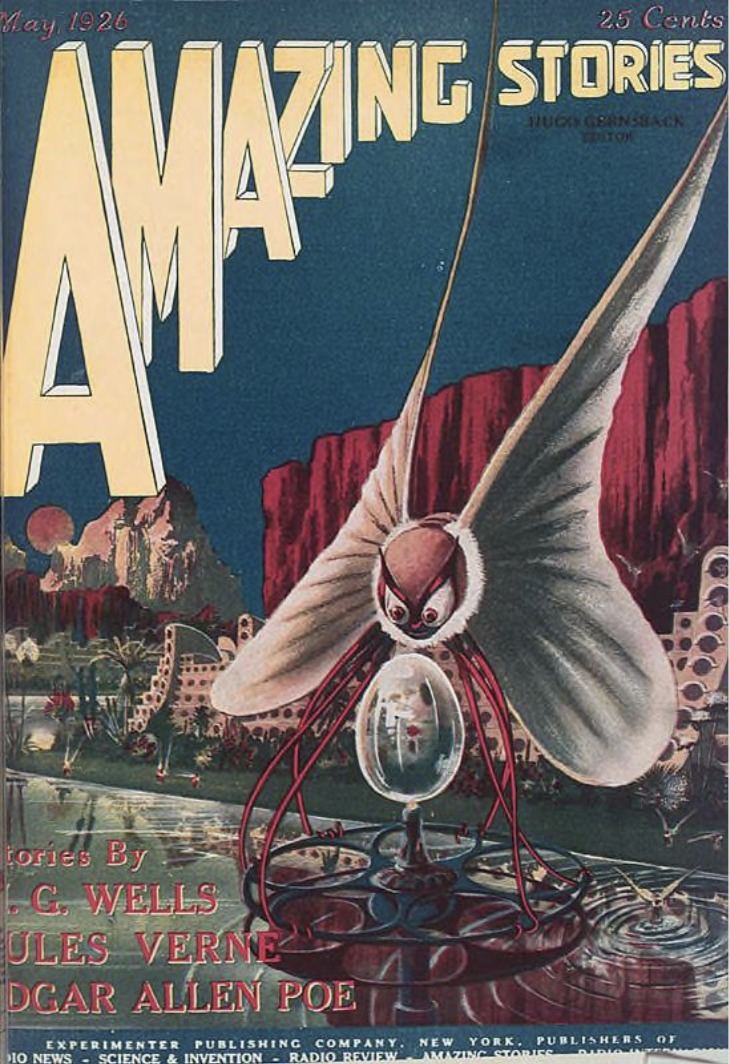
In 1905, a young immigrant from Luxembourg named Hugo Gernsback opened the Electro Importing Company in lower Manhattan, selling wireless telegraph kits through mail-order catalogs. Wireless was still a mystery to most Americans, an invisible force that seemed closer to magic than engineering. So he launched magazines like Modern Electrics, The Electrical Experimenter, and eventually Amazing Stories, filling them not just with circuit diagrams and technical explanations that made the incomprehensible graspable, but with speculative fiction about the futures these devices might create. He called this genre "scientifiction"—stories that were "a charming romance intermingled with scientific fact and prophetic vision." Education and imagination, bundled together. By 1912, an estimated 400,000 Americans—in a nation of 92 million—were experimenting with amateur radio, many of them building devices from Gernsback's catalogs, dreaming in the language of his stories. The annual Hugo Awards—science fiction's highest honor—still bear his name.
Tinkerers
Grant Wythoff's book The Perversity of Things: Hugo Gernsback on Media, Tinkering, and Scientifiction (2016) recovers this forgotten symbiosis between commerce, imagination, and hands-on experimentation. Through Gernsback's magazines, a generation of young readers—Isaac Asimov, Arthur C. Clarke, Ray Bradbury—first encountered the premise that the future was not something to passively await but something to build. The scientific imagination wasn't merely escapism; it was a blueprint. Fiction proposed; tinkerers prototyped. The magazines became forums where dispersed experimenters corresponded, formed clubs, and pushed each other toward new discoveries. This feedback loop—catalog to story to workbench and back—meant that every radio hobbyist soldering components in a basement was simultaneously an engineer and a science fiction character – or agent – inhabiting a narrative of technological progress even as they enacted it.
Vibing
"Vibe coding"—the practice of building software through natural language conversation with AI—might come to mind: a new medium that democratizes creation while demanding a kind of faith in the unseen. And just as Gernsback's readers were animated by visions of wireless utopia, today's tinkerers operate within a mythological framework no less potent. Erik Davis, in TechGnosis (1998), traced how mystical and gnostic impulses have always body-snatched the technologies that supposedly displaced them. That impulse is everywhere now—in the Singularity's promise of transcendence through superintelligence, in Aaron Bastani's Fully Automated Luxury Communism and its vision of post-scarcity abundance, in the relentless optimism of Silicon Valley's founding narratives.
Perspectives
- What was the culture of these early tinkerers? What were they making?
- Can you summarize any of the stories written by young Asimov, Clarke, or Bradbury? How did they present the future?
- How would you compare this culture in that historical period to our own? What analogies and disanalogies can we make?
- What is the correlation between the imagination of that historical period and what actually came to pass? What do the "misses" reveal about the imaginative constraints of that era?